Issue #76: Swift 6.3 Is Here, Swift on Android, Smarter Tests & One Very Important Date
Hey everyone! 👋
What a time to be a Swift developer. Seriously.
Swift 6.3 dropped and it's packed, the official Android SDK is here, Swift Testing keeps leveling up, and the @c attribute finally makes C interoperability feel like a first-class citizen. Oh, and if you've been sleeping on the agentic coding features in Xcode 26.3, we're covering that too because it's genuinely worth your time.
We've also got a deadline reminder that you really don't want to miss (April 28 is closer than it feels), and a shoutout to this year's Swift Student Challenge winners who, as always, have shipped some seriously creative work.
Alright, let's get into it. 🚀
Swift 6.3: Swift Testing Gets Smarter
Swift 6.3 (released March 24) brings three handy improvements to Swift Testing. First, warning issues let you record a non-fatal issue without failing the test:
Issue.record("Something suspicious happened", severity: .warning)Second, test cancellation lets you bail out mid-test gracefully — useful for skipping specific arguments in a parameterized test, or responding to conditions that make continuing pointless:
try Test.cancel()And third, image attachments let you attach UIImage, CGImage, CIImage, or NSImage instances directly to your test reports for visual verification — especially handy for snapshot tests or Vision framework work. These are exposed via new cross-import overlay modules with UIKit and friends.
 Apple Inc.
Swift 6.3: Swift Goes Android
The headline feature of Swift 6.3: the first official Swift SDK for Android. With it you can write native Android apps in Swift, update existing Swift packages to support Android builds, and use Swift Java and Swift Java JNI Core to slot Swift code into apps already written in Kotlin or Java.
// Swift code callable from an Android Kotlin app via Swift Java JNI Core
@_silgen_name("Java_com_example_MyApp_greet")
public func greet() -> String {
    return "Hello from Swift on Android!"
}
This doesn't mean Kotlin is going anywhere, it remains the primary language for Android development. But for teams already deep in Swift for iOS, this opens a path to sharing business logic across platforms without a rewrite.
 Apple Inc.
Swift 6.3: The @c Attribute
Swift 6.3 also formalizes the long-unofficial @_cdecl attribute into the new @c attribute, letting you expose Swift functions and enums directly to C code:
@c public func MyLib_initialize() {
    // Swift implementation, callable from C
}
When combined with @implementation, the compiler will validate that your Swift function's signature matches a pre-existing declaration in a C header — catching mismatches at compile time rather than surfacing them as cryptic "deserialization" failures at runtime.
 Apple Inc.
Xcode 26.3: Agentic Coding
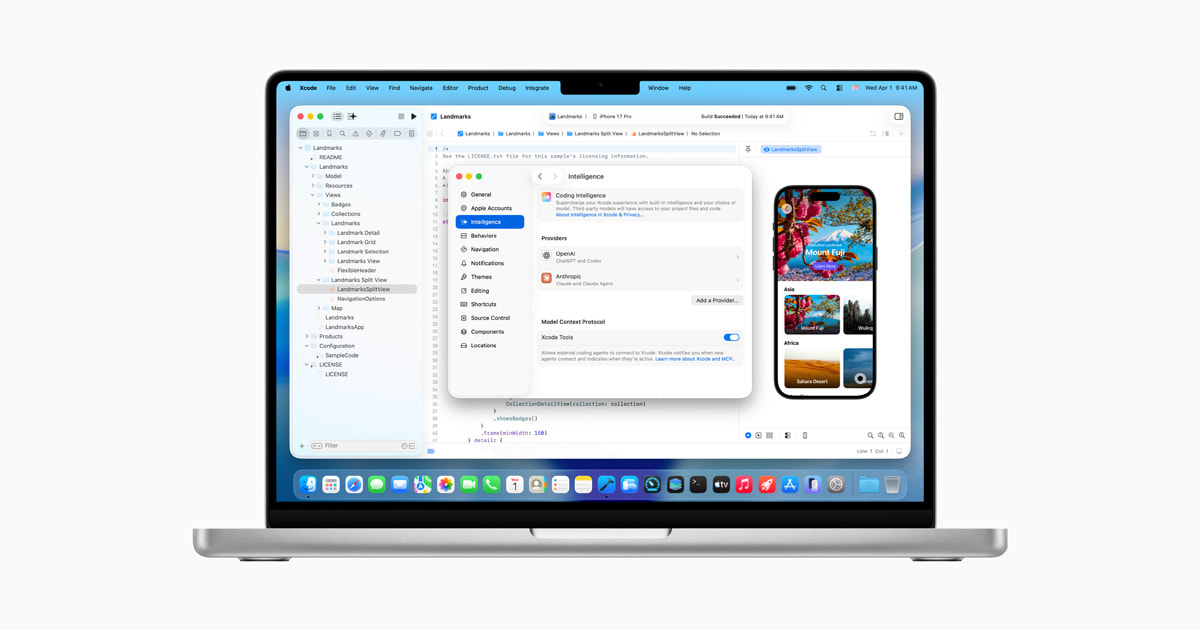
If you haven't tried it yet, Xcode 26.3 shipped in late February and introduced agentic coding with Claude Agent and OpenAI Codex baked in. Rather than just suggesting completions, agents can now reason across your whole project: exploring file structures, updating settings, running builds, capturing Xcode Previews to verify UI, and iterating until tests pass.
You stay in control, the agent logs everything in a transcript, automatic milestones let you roll back any change without touching Git, and you can swap between agents mid-project depending on the task.
Any MCP-compatible agent can also plug in via the open Model Context Protocol, it's not just Claude and Codex.

SDK Deadline: April 28
Reminder, since it's coming up fast. Starting April 28, 2026, apps and games uploaded to App Store Connect need to be built with the iOS 26 & iPadOS 26 SDK or later Apple Developer — same applies to tvOS, visionOS, and watchOS. If you haven't migrated to Xcode 26 yet, that clock is ticking.

Swift Student Challenge 2026 Winners
Apple began notifying students who won the WWDC 2026 Swift Student Challenge this week. MacRumors Winners receive AirPods Max 2, a one-year Apple Developer membership, and a certificate. 50 Distinguished Winners will be invited to Apple Park for a three-day experience including the WWDC Special Event keynote on June 8. MacRumors
Worth browsing the winners' submissions, they're always a great source of creative SwiftUI and Swift Playgrounds ideas.

✌️ That's a wrap for Issue #76! Big month for Swift, a new language version, the Android SDK landing officially, and agentic coding now stable in Xcode. Lots to explore.
As always, reply with what you want covered next. See you in two weeks! 🚀
Member discussion